
Faculty of Law – Jamia Millia Islamia (JMI)


Description
About Faculty of Law – Jamia Millia Islamia (JMI)
Verified by Lawsection.in Editorial Team | Updated: April 21, 2026
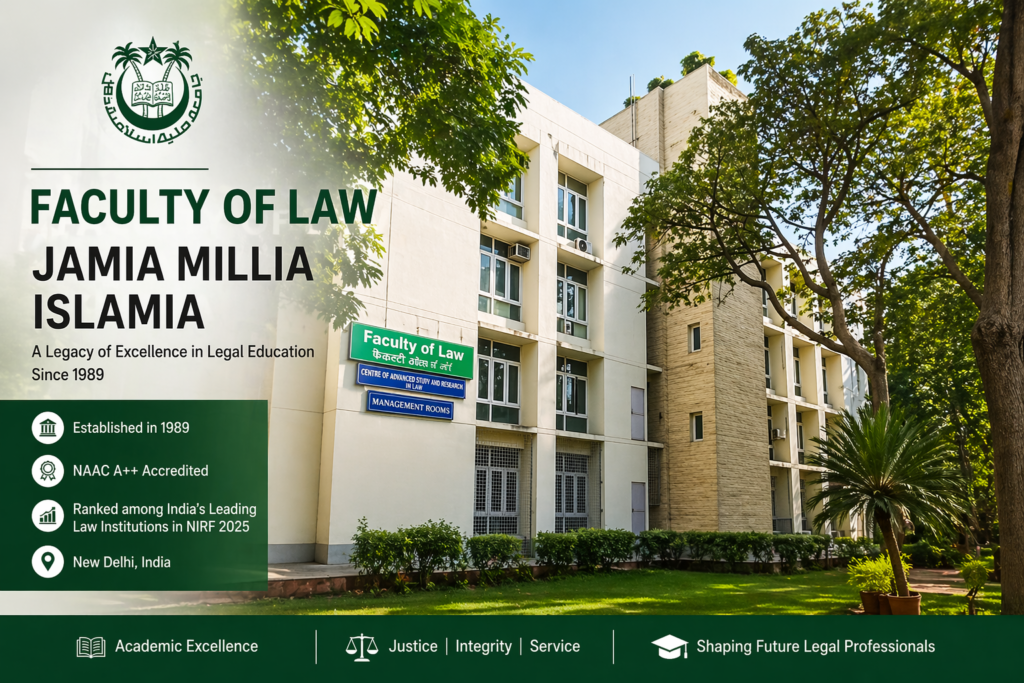
The Faculty of Law, Jamia Millia Islamia (JMI), New Delhi, is the law faculty of Jamia Millia Islamia, a Central University established under the Jamia Millia Islamia Act, 1988. The Faculty was established in 1989 and has since developed its academic programmes, clinical legal education, and legal research activities.
Since its establishment, the Faculty has expanded and restructured its legal education programmes while strengthening clinical legal training. Initially, the Faculty introduced a three-year LL.B. programme. However, from the 2002–2003 academic session, the five-year integrated B.A. LL.B. (Hons.) programme replaced the three-year LL.B. course. The Faculty also offers a two-year LL.M. programme in three specialised streams and a Ph.D. programme in Law.
Jamia Millia Islamia is a Central University established by an Act of Parliament. Students considering the B.A. LL.B. (Hons.) programme for professional legal practice should review the current regulatory and enrolment requirements under applicable Bar Council of India rules and the latest JMI admission documents.
Furthermore, Jamia Millia Islamia holds NAAC A++ accreditation and was ranked 8th in the Law category in the NIRF Rankings 2025.
University Snapshot
Location
New Delhi, India
University Type
Central University (Public University)
Establishment of Faculty of Law
1989
Governing Law
Jamia Millia Islamia Act, 1988 (Act No. 59 of 1988)
NAAC Accreditation
A++
NIRF Status (Law)
Ranked 8th in the Law category in NIRF 2025
Admission Cycle
As per the current JMI admission schedule
Law Programs Offered by the University
Currently, the Faculty of Law at JMI offers undergraduate, postgraduate, doctoral, and postgraduate diploma programmes. The major law programmes are listed below.
B.A. LL.B. (Hons.) – Regular / Self-Financed
Duration: 10 Semesters (5 Years)
Eligibility: As specified in the current JMI admission prospectus
Admission: As per the current JMI admission process
Approx Fees: Refer to the prospectus for the current academic session
LL.M. – Regular / Self-Financed
Duration: 4 Semesters (2 Years)
Specialisations: Personal Laws, Corporate Laws, and Criminal Laws
Eligibility: As specified in the current JMI admission prospectus
Admission: As per the current JMI admission process
Approx Fees: Refer to the prospectus for the current academic session
Ph.D. in Law
Programme Level: Doctoral
Eligibility: As specified under the current JMI Ph.D. admission rules
Admission: As per the current JMI Ph.D. admission process
Fees: Refer to the applicable university rules and current admission documents
The Faculty also offers specialised postgraduate diploma programmes, including:
1: P.G. Diploma in Air and Space Laws
2: P.G. Diploma in Labour Laws
Recognition and Accreditation
The Faculty of Law at Jamia Millia Islamia enjoys strong academic and regulatory recognition.
- Jamia Millia Islamia is a Central University established under the Jamia Millia Islamia Act, 1988.
- The university is recognised by the UGC.
- Students pursuing the B.A. LL.B. (Hons.) programme for professional legal practice should review the current regulatory and enrolment requirements under applicable Bar Council of India rules.
- Jamia Millia Islamia presently holds NAAC A++ accreditation.
- Jamia Millia Islamia ranked 8th in the Law category in the NIRF Rankings 2025.
Why Choose Faculty of Law – JMI?
The Faculty offers legal education within a Central University environment and has continuously restructured its courses and syllabi to meet changing legal education requirements.
Moreover, the Faculty provides an academic and practical training environment for students interested in litigation, legal research, public service, and other law-related career pathways.
Moreover, the Faculty places considerable emphasis on:
- Clinical legal education
- Legal aid activities through its Legal Services Clinic
- Moot court participation
- Client counselling
- Practical legal training
- Curricular and co-curricular development
In addition, the Faculty’s location in New Delhi places students within a major centre for courts, public institutions, legal organisations, and professional legal activity.
Rankings & Reputation (2026 Verified)
- Jamia Millia Islamia was ranked 8th in the Law category in the NIRF Rankings 2025.
- The university presently holds NAAC A++ accreditation.
- Jamia Millia Islamia is recognised as a Central University under the Jamia Millia Islamia Act, 1988.
- The Faculty places strong emphasis on clinical legal education, legal aid activities, moot court participation, client counselling, and practical legal training.
Documents Required
Applicants should prepare the academic, identity, and programme-specific documents required under the current JMI admission instructions. These may include:
- Class 10 and Class 12 mark sheets and certificates
- Graduation mark sheets and degree certificate, if applicable
- LL.B. degree and mark sheets for LL.M. applicants
- LL.M. degree and related documents for Ph.D. applicants
- Valid photo identification
- Passport-size photographs
- Passport copy and visa-related documents for international applicants
Admission Process
Students seeking admission to the Faculty of Law should follow the process below:
- Visit the official JMI admission portal.
- Select the relevant law programme.
- Carefully review the eligibility conditions and admission instructions.
- Complete the online application form.
- Upload all required academic and identity documents.
- Pay the prescribed application fee.
- Complete the applicable entrance or admission requirements specified for the selected programme.
- Wait for the merit list or admission offer.
- Complete document verification and fee payment.
International Student Admission Process
International students can also apply to the Faculty of Law. Generally, the process includes the following steps:
- Choose the desired programme from the official JMI website.
- Confirm the programme-specific eligibility and international admission requirements.
- Prepare all required educational and identity documents.
- Submit the application through the university admission portal.
- Receive the admission offer from the university.
- Apply for an Indian student visa.
- Complete registration after arrival in India.
Best Law Institutes in New Delhi, NCR and Other Leading Locations in North India
New Delhi is one of India’s most important centres for legal education, judicial institutions, public policy, and professional legal practice. Students exploring undergraduate, postgraduate, or doctoral legal education may consider the Faculty of Law at Jamia Millia Islamia (JMI) alongside other recognised universities and law institutions located across Delhi, the National Capital Region (NCR), and nearby North Indian education hubs.
Law institutions in Delhi and the wider NCR region differ in their statutory status, admission processes, programme structures, academic focus, faculty expertise, legal research opportunities, moot court activities, internships, campus facilities, and career support. Therefore, applicants should carefully compare these factors before selecting a university or law school.
The Faculty of Law at Jamia Millia Islamia offers legal education with a strong emphasis on clinical training, legal aid, moot court participation, client counselling, and practical legal education. Its location in New Delhi, Central University setting, and undergraduate, postgraduate, doctoral, and postgraduate diploma study options make it a relevant institution for students comparing legal education opportunities in Delhi and the wider NCR region.
In addition to JMI, students may explore other established universities and law institutions according to their preferred programme, admission route, location, academic interests, and career goals.
Leading Law Institutes in New Delhi and NCR
| Law Institute | Highlights |
|---|---|
| Faculty of Law, Jamia Millia Islamia (JMI), New Delhi | Central University law faculty offering undergraduate, postgraduate, doctoral, and postgraduate diploma programmes, with emphasis on clinical legal education, legal aid, moot court participation, and practical training. |
| Faculty of Law, University of Delhi (DU), Delhi | Established Central University law faculty offering legal education through its law centres and known for its strong academic and litigation-oriented environment. |
| National Law University Delhi (NLU Delhi) | National Law University offering specialised legal education, research opportunities, and interdisciplinary academic exposure. |
| University School of Law and Legal Studies, Guru Gobind Singh Indraprastha University (GGSIPU), Delhi | University law school offering integrated and advanced legal education with academic and professional exposure. |
| Campus Law Centre, University of Delhi, Delhi | Established law centre offering the three-year LL.B. programme with significant exposure to litigation, public law, and Delhi’s legal institutions. |
| Amity Law School, Noida, Amity University Uttar Pradesh | Private university law school offering undergraduate, postgraduate, and research-oriented legal education. |
| School of Law, Justice & Governance, Gautam Buddha University (GBU), Greater Noida | State public university law school offering interdisciplinary legal education with an academic focus on law, justice, governance, and public policy. |
Other Law Institutes to Explore in North India
Students comparing legal education options in Delhi, NCR, and other leading North Indian locations may also explore:
- Faculty of Law, Aligarh Muslim University (AMU), Aligarh
- Faculty of Law, Banaras Hindu University (BHU), Varanasi
- Dr. Ram Manohar Lohiya National Law University (RMLNLU), Lucknow
- Faculty of Law, University of Lucknow
- Dr. Rajendra Prasad National Law University (RPNLU), Prayagraj
- Rajiv Gandhi National University of Law (RGNUL), Punjab
- Faculty of Law, Panjab University, Chandigarh
Before selecting a law institution, applicants should compare its statutory status, applicable regulatory requirements, programme eligibility, admission process, curriculum, faculty profile, legal research opportunities, moot court activities, internships, career support, campus infrastructure, scholarships, and alumni engagement.
By evaluating these factors, students can identify law institutions that align more closely with their academic interests, preferred legal career pathway, location preferences, and financial considerations.
Frequently Asked Questions (FAQs)
1. Can JMI law graduates pursue professional legal practice in India?
Graduates intending to enter professional legal practice should complete the applicable State Bar Council enrolment and All India Bar Examination requirements under the prevailing Bar Council of India framework. Applicants should also verify the current regulatory status and professional requirements applicable to their programme.
2. Does JMI require CLAT or LSAT for admission?
Admission requirements depend on the selected programme. Applicants should follow the entrance and admission process specified in the current JMI prospectus and official admission schedule.
3. Can B.A. LL.B. graduates practise law immediately after completing the degree?
Graduates who intend to practise as advocates must complete the applicable State Bar Council enrolment and All India Bar Examination requirements under the prevailing regulatory framework.
4. Is Jamia Millia Islamia a Central University?
Yes. Jamia Millia Islamia is a Central University established under the Jamia Millia Islamia Act, 1988, enacted by Parliament.
5. Does JMI offer a self-financed law programme?
Yes. The Faculty’s programme information includes self-financed options for the B.A. LL.B. (Hons.) and specialised LL.M. programmes. Applicants should verify current availability through the latest JMI prospectus.
6. What is the current ranking status of the Faculty of Law, JMI?
Jamia Millia Islamia was ranked 8th in the Law category in the NIRF Rankings 2025.
Study LLM Abroad: Top Law Universities in UK, USA & Canada
Planning to pursue an LLM abroad? Explore carefully curated and verified guides to top-ranked law universities in the United Kingdom, United States, and Canada. These country-wise pages provide structured information on admission requirements, eligibility criteria, tuition fees, intakes, scholarships, and career prospects — based on official university sources and updated as of 2026. Compare destinations confidently and choose the best pathway for your global legal career.
LLM In UK
Find the best Law Universities in United Kingdom.
LLM In USA

Explore Top-ranked Law Universities in the USA.
LLM in Canada
Canada’s Top-ranked Law Universities listed here.
This information is curated by Lawsection’s editorial team as part of our Study Law Abroad and Global Law College Directory initiatives.
Information reviewed using official Jamia Millia Islamia sources, the JMI admission prospectus, NIRF 2025 information, and publicly available accreditation information.
Applicants should always verify the latest admission rules, fee structure, and eligibility requirements through the official JMI admission prospectus and university website before applying.
Address







Cardiff Metropolitan University, UK – Law Courses, Fees, Eligibility, Admissions 2026
- Government
- LLB (3 Years), LLM Abroad, Juris Doctor (JD), PhD in Law




Wrexham University Law Courses in UK (2026): Fees, Entry Requirements, Admissions & Student Guide
- Government
- LLB (3 Years), LLM Abroad, Juris Doctor (JD), PhD in Law



Cardiff University, UK – Law Courses, Fees, Admission Requirements & Study Opportunities (2026)
- Government
- LLB (3 Years), LLM Abroad, Juris Doctor (JD), PhD in Law


Swansea University Law School (UK): Courses, Fees, Eligibility, Admissions, Rankings & Study Guide 2026
- Government
- LLB (3 Years), LLM Abroad, Juris Doctor (JD), PhD in Law



Bangor University, UK – Law Courses, Fees, Eligibility, Admissions & Bangor Law School Guide (2026)
- Government
- LLB (3 Years), LLM Abroad, Juris Doctor (JD), PhD in Law



Queensland University of Technology Law School Australia: Courses, Fees, Eligibility, Admissions & Career Opportunities 2026
- Government
- LLB (3 Years), LLM Abroad, Juris Doctor (JD), Doctor of Juridicial Science (S.J.D), PhD in Law



Griffith University, Australia – Complete Guide to Law Programs, Fees, Eligibility, Campuses & Admissions (2026)
- Government
- LLB (3 Years), LLM Abroad, Juris Doctor (JD), Doctor of Juridicial Science (S.J.D), PhD in Law
